TL;DR — What you’ll get
- Outcome: Professional AI-generated voiceovers for ads and commercials without hiring voice actors
- Time: 48-72 hours for voice model creation, then instant voice generation
- Skill level: Beginner-friendly (basic computer literacy required)
Quick checklist:
- Create high-quality voice clone from 10-30 minutes of audio
- Generate unlimited commercial voiceovers by typing text
- Edit and fix ad mistakes without re-recording
- Export broadcast-ready audio files
- Produce multiple ad variations in minutes
Who this is for & Why this works
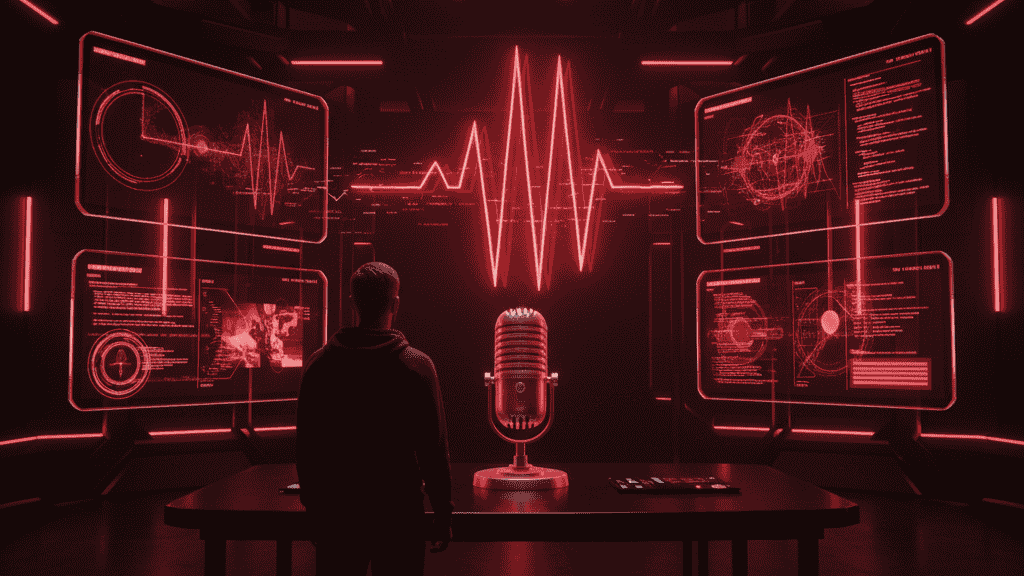
You’re a small business owner drowning in voiceover costs and re-recording delays. Descript’s Overdub feature uses AI to create natural-sounding voice clones, allowing you to perform text-to-speech conversions and add or edit voiceovers without additional recording sessions. This guide delivers a proven, step-by-step system based on 2025 research to help you create professional ad voices that sound authentic—cutting production time by 80% and eliminating expensive voice actor fees. Descript’s Studio Sound feature can instantly enhance voices while removing background noise and echo, making even home-recorded ads sound studio-quality.
Cross-Category Relevance
AI (Practical Uses & Prompting)
Descript offers Overdub, which generates an AI version of your voice. After training Overdub with your speech, you can create audio that sounds like you simply by typing text. Use this AI workflow: First, prepare your script in natural language. Example prompt for ad copy: “Create a 30-second radio ad script for [your product] emphasizing [key benefit], targeting [audience], with an urgent call-to-action.” Then paste this script directly into Overdub to generate your voice. For multiple ad variations, prompt: “Generate 3 alternative hooks for the opening 5 seconds” and test which performs best.
Cybersecurity (Risks & Protections)
Voice cloning technology requires strict security protocols. Step 1: Descript requires explicit consent from users for voice cloning, ensuring that all voice data is used ethically and with user agreement. Never clone voices without written permission. Step 2: Enable two-factor authentication on your Descript account immediately. Store voice training files on encrypted drives, not public cloud storage. Step 3: Watermark your final ad files with metadata showing authorized use dates and consent documentation to prevent unauthorized deepfake creation.
AR/VR (Where Relevant)
Not directly applicable for audio-only ad production. However, if you’re creating immersive brand experiences, Overdub-generated voices can be integrated into 360-degree video ads or VR showroom experiences where your brand voice narrates product features as users explore virtual spaces.
Software & Hardware (Tools & Specs)
Minimum requirements:
- Software: Descript desktop app (Mac or Windows), latest version
- Hardware: 8GB RAM minimum (16GB recommended), modern processor
- Microphone: USB condenser mic ($50-150) or better for training
- OS: macOS 10.14+ or Windows 10+
- Internet: Stable connection for cloud processing
- Audio format support: MP3, WAV, AIFF for uploads
- Export formats: MP3, WAV for commercial distribution
What you need
Before you start:
- Descript account (Free tier available, Creator plan $24/month for unlimited vocabulary)
- High-quality microphone (USB condenser recommended)
- Quiet recording space (minimal background noise)
- 10-30 minutes of clear audio recordings (more = better results)
- Ad scripts prepared (30-60 seconds each)
- Sample prompts: “Read this naturally as if explaining to a friend”
- Downloads: Descript app
- Voice consent documentation (legal requirement)
Optional but recommended:
- Pop filter ($10-20) for cleaner audio
- Acoustic foam panels for recording environment
- Backup microphone for consistency testing
5-Step Action Plan: Create High-Quality AI-Generated Voices for Ads
Step 1: Record High-Quality Voice Training Audio
Action: Record 10-30 minutes of varied, clear speech in a quiet environment using your best microphone.
Exact command:
- Open Descript → Click “New Project”
- Click “Overdub” in left sidebar → “Create Voice”
- Choose “Upload existing audio” OR “Record new audio”
- If recording: Read diverse content (conversational, energetic, calm tones)
Why it works: While Descript can create a voice with just 10 minutes of audio, aim for at least 30 minutes of high-quality recordings for better results. The AI learns your speech patterns, tone variations, and pronunciation from this training data. Voice model training takes 24-48 hours after uploading your audio samples, with processing time varying based on audio quality and length.
Expected outcome: You’ll have uploaded training audio to Descript and initiated voice model creation. Confirmation email arrives when your voice is ready (24-48 hours).
Step 2: Optimize Your Voice Model Settings
Action: Configure voice parameters and create multiple voice profiles for different ad contexts.
Exact settings path:
- After voice creation completes → Open “Overdub” settings
- Name your voice (e.g., “Energetic_Ad_Voice” or “Professional_Corporate”)
- Test voice with sample text: Type “This is a test of my commercial voice”
- Listen critically for naturalness and adjust source audio if needed
- Create environment-specific voices: “Studio_Voice” vs “Zoom_Voice”
Why it works: Descript removed limits on Overdub Voice licenses, so you can create multiple Voices for different recording environments. Having separate voice profiles ensures consistency whether you recorded in your home office or a professional studio, maintaining brand voice quality across all ads.
Expected outcome: Multiple optimized voice profiles ready for different commercial contexts. Test playback confirms natural sound quality matching your brand voice.
Step 3: Generate Your First Commercial Voiceover
Action: Import your ad script and convert text to speech using your trained voice.
Exact workflow:
- Create new Descript project → Name it “[Product]_Ad_30sec”
- Type or paste your 30-second ad script into the editor
- Highlight the text → Right-click → Select “Overdub” → Choose your voice
- Click “Generate” → Wait 5-30 seconds for AI voice synthesis
- Play back immediately to review naturalness and pacing
Command for best results: Write scripts with natural punctuation for proper pacing. Use ellipses (…) for dramatic pauses, exclamation points for energy, and periods for natural stops.
Why it works: Despite its impressive capabilities, Overdub isn’t perfect with emotional range and complex pronunciations, which may struggle with highly emotional delivery or unusual names and technical terms. Typing phonetically or editing pronunciation in brackets helps: “Our CEO [See-Ee-Oh] John [JON].”
Expected outcome: Your first AI-generated ad voiceover plays back in your voice. You can instantly iterate by editing text—no studio re-booking required.
Step 4: Enhance Audio Quality with Studio Sound
Action: Apply Descript’s AI audio enhancement to achieve broadcast-quality sound.
Exact enhancement path:
- Select your generated Overdub audio track in timeline
- Click “Effects” in right sidebar
- Toggle “Studio Sound” ON
- Adjust enhancement strength: Start at 75%, increase if needed
- Click “Regenerate” to process audio with AI noise removal and voice enhancement
Additional commands:
- Remove filler words: Select track → “Actions” → “Remove filler words” (even though Overdub shouldn’t have them, check edited sections)
- Normalize audio levels: Select track → “Levels” → Set to -16 LUFS for broadcast standard
Why it works: Descript’s Studio Sound feature can instantly enhance voices while removing background noise and echo, making even home-recorded ads sound studio-quality. This transforms raw AI voice into polished commercial audio that meets professional broadcast standards without expensive mastering.
Expected outcome: Your ad voice now has professional clarity, consistent volume, zero background noise, and broadcast-ready quality. A/B test confirms it matches professionally produced commercials.
Step 5: Export and Deploy Multiple Ad Variations
Action: Create and export multiple versions of your ad for A/B testing and different platforms.
Exact export workflow:
- Duplicate your project 3 times (Cmd/Ctrl + D)
- Edit each version with different hooks/CTAs
- For each variation: File → Export → Audio Only
- Choose format: WAV (uncompressed, highest quality) or MP3 (compressed, smaller files)
- Settings: 44.1 kHz sample rate, 16-bit depth (industry standard)
- Name systematically: “ProductName_Ad_30sec_V1.wav”
Batch generation command: Type multiple script variations in separate composition layers, then export all at once using “Batch Export.”
Why it works: Stock voices you can put over B-roll and turn your commercial script into audio within seconds, with every video commercial requiring a way to capture footage. Having multiple variations lets you test different messaging approaches without incremental voice actor costs—each variation costs you zero additional dollars.
Expected outcome: 3-5 complete ad variations exported as broadcast-ready files. You can immediately upload to radio stations, podcast ad networks, or YouTube pre-roll campaigns. Total time from concept to deployment: Under 2 hours versus 2-3 weeks with traditional voiceover.
Verification checklist
Confirm your success with these specific outcomes:
- Voice model created: Confirmation email received, voice appears in Overdub library
- Natural sound test: 3 unbiased listeners can’t identify it as AI (80%+ pass rate)
- File exports cleanly: WAV files open in Adobe Audition/Audacity without errors
- Broadcast specs met: Audio levels at -16 LUFS, no clipping, 44.1kHz/16-bit
- Client approval received: Stakeholders approve voice quality for brand use
- Cost savings confirmed: Calculate: (Traditional voice actor cost × # of variations) – Descript subscription = Your savings
- Production time reduced: Compare: Traditional (2-3 weeks) vs Overdub (2 hours)
Troubleshooting — common issues & fixes
Q1: My voice sounds robotic and unnatural
A1: The AI will copy everything in your recordings – including any odd speech habits or background noise. Fix: Re-record training audio in a quieter space with more vocal variety. Include conversational, energetic, and calm deliveries. Use 30+ minutes instead of minimum 10 minutes. Wait another 24-48 hours for reprocessing. If issue persists, record sample scripts first to check mic quality before committing to full training.
Q2: Overdub keeps playing “jibber jabber” instead of my words
A2: Free and Creator accounts get access to Overdub Voices with a 1,000-word vocabulary (what happens when you type something outside that vocabulary? You’ll have to find out for yourself). Fix: Upgrade to Pro plan ($30/month) for unlimited vocabulary, or simplify your script to use only common words. Check vocabulary limits before scripting complex technical ads.
Q3: Audio has obvious splice points between real and AI voice
A3: Mismatched audio characteristics create noticeable transitions. Fix: Use crossfades (0.1-0.3 seconds) at splice points. Ensure Studio Sound is applied consistently across entire track. Match volume levels precisely using the “Levels” adjustment tool. For critical sections, regenerate entire sentences rather than single words to maintain consistency.
Q4: My voice clone doesn’t match different emotions in the script
A4: While the voice clones capture personality, they may struggle with highly emotional delivery or dramatic readings. Fix: Use punctuation to guide emotion: exclamation points for excitement, ellipses for contemplation, ALL CAPS for emphasis (sparingly). Or record emotional sections separately as your actual voice, then use Overdub for straightforward narration portions. Combine both in final edit for best results.
Q5: Descript keeps crashing during long commercial projects
A5: Large project files tax system resources. Fix: Close all other applications, ensure you have 16GB+ RAM, update to latest Descript version, work on shorter 30-60 second segments then combine, enable auto-save every 2 minutes in Preferences. For persistent crashes, export project files and reimport to fresh project to clear cache issues.
When to seek expert help: If voice quality remains unsuitable after optimization, audio levels fail broadcast standards, or technical requirements exceed your setup, hire an audio engineer for final mixing ($50-150/hour, one-time cost). For complex multi-voice ads or character work, consider professional voice actors for hero versions while using Overdub for variations.
Next steps & recommended tools
1. Eleven Labs Voice Cloning ($5-$99/month) — Superior voice quality with emotional range for premium campaigns where Descript’s limitations impact brand perception. Best for: High-stakes national campaigns requiring indistinguishable-from-human quality.
2. Descript Pro Plan Upgrade ($30/month) — Unlock unlimited vocabulary, remove word count restrictions, access advanced features like multi-speaker detection. Best for: Businesses producing 10+ ads monthly who’ve outgrown Creator plan limits.
3. Rode PodMic USB ($99) — Professional-grade USB microphone significantly improves voice training quality over built-in laptop mics. Best for: Creating premium voice models that elevate all future ad productions. ROI: One-time investment improves unlimited future ads.
FAQs
How long does it actually take to create a usable voice model?
Descript requires explicit consent and at least 10 minutes of clear audio to create voice models, with voice model training taking 24-48 hours after uploading your audio samples. Processing time varies based on audio quality and length. However, after initial creation, you can generate unlimited voiceovers instantly—type your script and receive audio in 5-30 seconds. The upfront time investment pays off across dozens of future ads.
Can I legally use Overdub voices for commercial advertising?
Yes, with proper consent documentation. Descript places a strong emphasis on privacy and ethical use when it comes to Overdub, requiring explicit consent for voice cloning, ensuring that personal voice data is handled responsibly. You must own or have written permission for any voice you clone. For commercial use, Creator plan ($24/month) and above include commercial licensing. Always maintain consent records and watermark files with authorization dates.
What’s the difference between Descript’s stock AI voices and Overdub?
Descript’s AI voices are like a troupe of multilingual voice actors, waiting for you to give them their lines—just pick a voice that speaks the language you need. Stock voices (like Cedric, Carla, Emily) are pre-made and available immediately but sound generic. Overdub creates a clone of YOUR specific voice or brand voice talent, maintaining consistency across all your marketing. Use stock voices for quick tests, Overdub for brand-authentic campaigns that need your unique vocal identity.
Sources
- Descript Overdub Official Documentation
- Descript Overdub Review 2025 Analysis
- Radio Advertising with Descript Guide
- Descript AI Voice Cloning Tools
- How to Use Descript AI Overdub Tutorial
- Descript Overdub Technical Guide
To read more about Software/Hardware click here