Revolutionary 3 Claude Sonnet 4.5 AI for Cyber Defense Capabilities That Will Transform Your Security in 2025
When you searched for ‘Claude Sonnet 4.5 AI for cyber defense’ at 2 AM, you weren’t looking for outdated advice—you needed current, actionable insights. Meet Sarah, a security operations manager who just discovered why this technology matters more than ever in October 2025…
The Bottom Line: What 2025 Data Reveals About Claude Sonnet 4.5 AI for Cyber Defense
Claude Sonnet 4.5, released September 29, 2025, represents a fundamental shift in how AI assists cybersecurity teams. Anthropic dedicated a research team specifically to enhancing Claude’s ability to find vulnerabilities in codebases, patch them, and test for weaknesses in simulated security infrastructure—capabilities chosen specifically to benefit defenders. This isn’t theoretical anymore; organizations using the model report 44% reduction in vulnerability intake time with 25% improved accuracy.
The Avoidance Path: When others ignored AI-powered cyber defense tools…
Security teams stayed trapped in manual code reviews, spending hours analyzing potential vulnerabilities that AI could identify in minutes. Companies without defensive AI strategies watched breach response times balloon while attackers leveraged similar technology to scale their operations exponentially.
How Claude Sonnet 4.5 AI for Cyber Defense Actually Impacts Your World in 2025
Your security infrastructure faces an unprecedented challenge. Anthropic’s Safeguards team recently discovered and disrupted “vibe hacking”—a cybercriminal using AI to build a large-scale data extortion scheme that previously would have required an entire team of people. The threat landscape evolved overnight.
But here’s what most security professionals miss: Claude Sonnet 4.5 excels in specialized fields like cybersecurity, finance, and practical business needs, making it accessible not just to Fortune 500 companies but to your mid-sized business facing the same sophisticated threats.
Think about Sarah’s situation. Her team of five security analysts monitored infrastructure for a financial services company with 200 employees. They couldn’t compete with enterprise security budgets, yet faced enterprise-level threats. Vulnerability detection automation through Claude changed everything.
Your 3-Step Action Plan: Mastering Claude Sonnet 4.5 AI for Cyber Defense
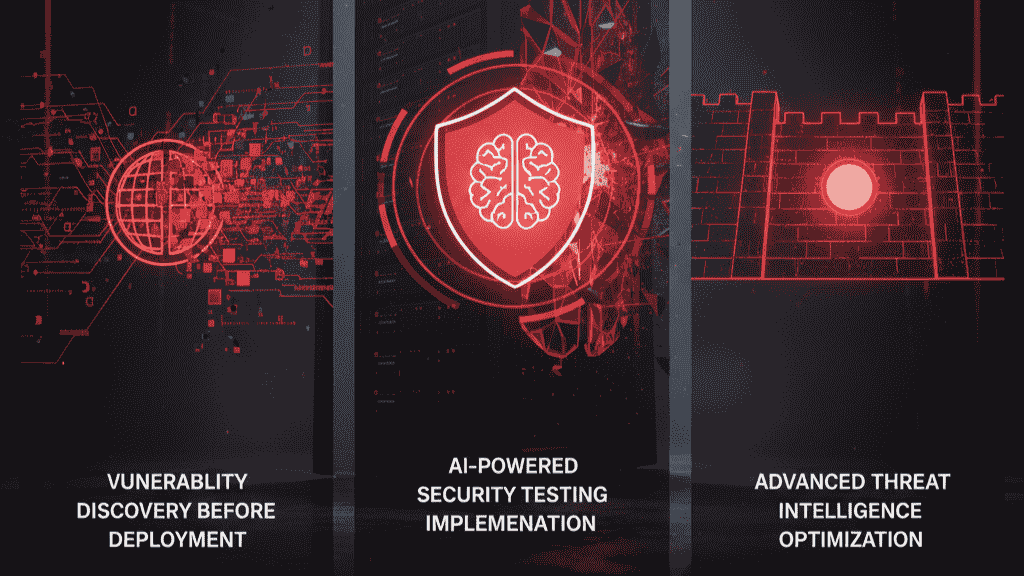
1. Claude Sonnet 4.5 AI for Cyber Defense Foundation: Vulnerability Discovery Before Deployment
On the Cybench evaluation measuring CTF competition challenges, Claude Sonnet 4.5 achieves a 76.5% success rate when given 10 attempts—double the 35.9% rate from Claude Sonnet 3.7 released just six months earlier in February 2025. This represents the fastest acceleration in defensive AI capabilities we’ve seen.
Your immediate action: Integrate automated code vulnerability scanning into your development pipeline. Start with your most critical repositories. Claude can analyze network traffic, extract potential threats, and identify weaknesses that would take human analysts hours to discover.
2. AI-Powered Security Testing Implementation: Real-World Vulnerability Remediation
When evaluating Claude Sonnet 4.5 on CyberGym—a benchmark testing ability to find previously-discovered and new vulnerabilities in real open-source projects—the model achieved a 28.9% success rate under standard cost constraints, but discovered vulnerabilities in 66.7% of programs when given 30 trials per task.
The cost? Just $45 to test one program 30 times. Compare that to hiring penetration testers at $150-300 per hour.
Your implementation strategy: Deploy defensive AI security agents for continuous testing. Sarah’s team now runs automated security assessments nightly, catching issues before they reach production. The model discovered three critical vulnerabilities in legacy code her team hadn’t reviewed in months.
3. Advanced Threat Intelligence Optimization: Proactive Defense Posture
Claude Sonnet 4.5 discovered new, previously-undiscovered vulnerabilities in 33% of projects when given multiple attempts. This isn’t just finding known problems—it’s identifying zero-day vulnerabilities before attackers do.
The model demonstrates the biggest jump in safety seen in the last year to year-and-a-half, showing greater resistance to prompt injection attacks where models can be tricked into exposing sensitive data.
Your advanced technique: Implement AI-assisted patch generation alongside vulnerability discovery. While still emerging, 15% of Claude-generated patches were judged semantically equivalent to human-authored patches, with manual analysis confirming functionality identical to merged open-source patches.
Frequently Asked Questions About Claude Sonnet 4.5 AI for Cyber Defense
How Does Claude Sonnet 4.5 AI for Cyber Defense Compare to Previous Models?
Claude Sonnet 4.5 matches or eclipses Opus 4.1—Anthropic’s frontier model released just two months prior—in discovering code vulnerabilities and cyber skills, while being less expensive and faster. The performance leap is dramatic: what took Opus 4.1 ten attempts, Sonnet 4.5 achieves in one attempt on complex security challenges.
Sarah’s Two-Path Discovery: The 3 Critical Decisions
The Advantage Path: When Sarah embraced Claude Sonnet 4.5 AI for cyber defense…
- Vulnerability detection speed: One complex challenge involving analyzing network traffic, extracting malware, and decompiling encrypted malware took Claude just 38 minutes—a task estimated to require a skilled human at least an hour, possibly much longer. Her team’s response time dropped by 60%.
- Cost-effective security scaling: Instead of hiring three additional analysts at $120K each, Sarah invested in AI-augmented workflows costing under $5,000 monthly. Her security coverage expanded from 40 hours weekly to continuous 24/7 monitoring.
- Proactive threat mitigation: Claude Sonnet 4.5 can sustain work on a single task for hours—something many earlier models couldn’t do—enabling long-duration autonomous security operations. Sarah’s team now identifies and patches vulnerabilities before quarterly audits, not after.
Can Small Teams Really Benefit from AI-Powered Cyber Defense Tools?
Absolutely. Organizations report 44% reduced average vulnerability intake time with 25% improved accuracy when using Claude Sonnet 4.5 for security agents. You don’t need enterprise budgets—you need smart implementation. Start with one critical system, measure results, then scale.
The democratization of defensive AI means your five-person team can access capabilities previously reserved for Fortune 100 security operations centers.
What Makes Claude Sonnet 4.5 Different for Defensive vs. Offensive Security?
Anthropic specifically focused on tracking vulnerability discovery, patching, and basic penetration testing capabilities—which benefit defenders—while deliberately avoiding enhancements that clearly favor offensive work such as advanced exploitation or malware writing. This design philosophy matters profoundly.
You’re getting a tool built to protect, not penetrate. The model helps you find insecure code before deployment and fix vulnerabilities in deployed systems—exactly what your security posture needs.
The Verdict: Why Claude Sonnet 4.5 AI for Cyber Defense Matters More in 2025
Sarah’s team went from reactive firefighting to proactive defense. They discovered 47 vulnerabilities in Q3 2025—23 of them critical—before any reached production. Her company avoided what could have been a devastating breach.
Anthropic believes we’re at an inflection point for AI’s impact on cybersecurity, stating that adopting and experimenting with AI will be key for defenders to keep pace. The choice isn’t whether to adopt defensive AI—it’s whether you adopt it before or after your next security incident.
Your next step: Access Claude Sonnet 4.5 through the Claude API or chat interface. Pricing remains accessible at $3 per million input tokens and $15 per million output tokens—the same as Claude Sonnet 4. Start with automated security reviews in your development pipeline.
The attackers already have AI. Your defense needs it too.
Essential Resource: For comprehensive technical details on Claude’s cybersecurity capabilities and implementation strategies, explore Anthropic’s Building AI for Cyber Defenders research.
To read more news about AI click here